the night Ronia is born
The Birth Storm
A violent thunderstorm drives the goblinfolk into hiding while [Wild harpies](entity:character-recall-character-wild-harpies-ec242bdb0134) circle [Matt’s Mountain](entity:location-recall-location-matt-s-mountain-0d281281f10c). As [Lovis](entity:character-recall-character-lovis-7310fd72cd02) sings through labor, [Matt](entity:character-recall-character-matt-49128ced0765) shoots at the harpies, then races to the great hall to announce the birth of a daughter. He and the robbers are overcome by the helpless newborn, whom Lovis names [Ronia](entity:character-recall-character-ronia-2583bf9bc80a).
the morning after Ronia’s birth
The Fort Splits
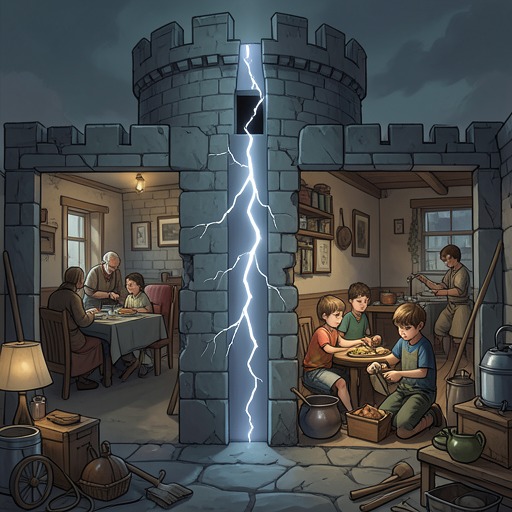
A tremendous crack of thunder frightens the robbers, and [Ronia](entity:character-recall-character-ronia-2583bf9bc80a)’s cry unsettles [Matt](entity:character-recall-character-matt-49128ced0765) more than the storm. In the morning they discover that lightning has split [Matt’s Fort](entity:location-recall-location-matt-s-fort-66031fdeab82) from battlements to dungeon, leaving [Hell’s Gap](entity:location-recall-location-hell-s-gap-538ad41f41b5) between its halves. The damage changes the fortress’s shape but not the family’s home life; Matt chiefly laments the loss of the outhouse.
Ronia’s early childhood
A Robber Household
[Ronia](entity:character-recall-character-ronia-2583bf9bc80a) grows up among [Matt](entity:character-recall-character-matt-49128ced0765) and his twelve robbers, who dote on her and return early from their work to watch her eat porridge. [Lovis](entity:character-recall-character-lovis-7310fd72cd02) tolerates their softened manners but reminds Matt that he is neglecting his duties. Ronia learns the robbers’ songs and dances, while Matt boasts that she is as splendid as a Wild harpy.
when Ronia is old enough to explore
The Forest Opens
[Matt](entity:character-recall-character-matt-49128ced0765) finally agrees that [Ronia](entity:character-recall-character-ronia-2583bf9bc80a) should learn what life is like in [Matt’s Forest](entity:location-recall-location-matt-s-forest-5b7be8b84beb). He warns her about [Wild harpies](entity:character-recall-character-wild-harpies-ec242bdb0134), [Gray dwarfs](entity:character-recall-character-gray-dwarfs-1efd486edec3), [Borka’s robbers](entity:character-recall-character-borka-s-robbers-020dac0ad9dd), the river, and [Hell’s Gap](entity:location-recall-location-hell-s-gap-538ad41f41b5), while offering blunt instructions for what to do if she gets lost or falls in. [Lovis](entity:character-recall-character-lovis-7310fd72cd02) welcomes the decision, having wanted Ronia to explore earlier.
Ronia’s first day exploring alone
The First Forest Day
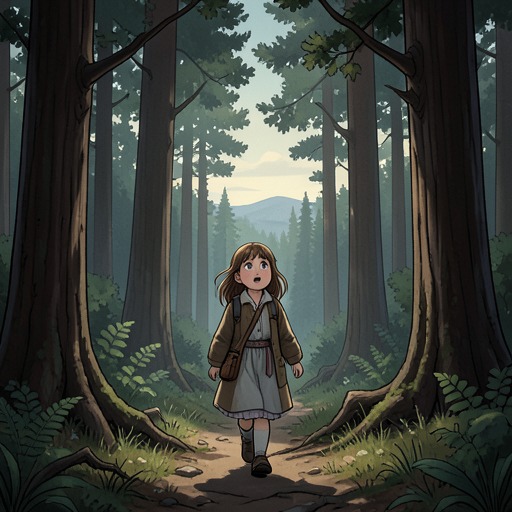
[Ronia](entity:character-recall-character-ronia-2583bf9bc80a) discovers that the world is far larger than the fort or mountain: she finds the rushing river, the dark forest, and a lake bright with water lilies. She spends the day climbing, splashing, and watching the trees, then falls asleep on the moss. At night the stars make her realize that the world still extends beyond anything she can reach.
the evening of Ronia’s first forest day
Gray Dwarfs at the Lake
Returning for her food bag in the dark, [Ronia](entity:character-recall-character-ronia-2583bf9bc80a) sees a ring of gleaming eyes around her boulder. [Gray dwarfs](entity:character-recall-character-gray-dwarfs-1efd486edec3) crowd toward her, chanting threats and beating the stone until she is terrified and trapped. [Matt](entity:character-recall-character-matt-49128ced0765) arrives with his robbers and drives them away, then explains that fear itself makes the Gray dwarfs dangerous; Ronia resolves to practice courage.
the days after Ronia’s first forest day
Learning the Forest’s Dangers
[Ronia](entity:character-recall-character-ronia-2583bf9bc80a) practices staying calm by negotiating the slippery riverbank and climbing the cliffs beside the waterfalls. Each frightening passage becomes familiar through repetition, and she grows strong, agile, and confident around the forest’s dangers. She also explores [Matt’s Fort](entity:location-recall-location-matt-s-fort-66031fdeab82) and its hidden passages, though the woods remain her preferred world.
Ronia’s early years of roaming
A Forest Without Fear
[Ronia](entity:character-recall-character-ronia-2583bf9bc80a) ranges freely while [Matt’s robbers](entity:character-recall-character-matt-s-robbers-22aaa6f1e0f2) return each evening with goods whose origins she does not yet question. She hears the men speak of [Borka](entity:character-recall-character-borka-81cf6a30f1f1)’s misfortunes under pressure from the [Sheriff’s men](entity:character-recall-character-sheriff-s-men-3367c42a892c), but believes [Matt](entity:character-recall-character-matt-49128ced0765)’s band to be better than their rivals. The robbers boast that [Matt’s Fort](entity:location-recall-location-matt-s-fort-66031fdeab82) is secure behind the [Wolf’s Neck](entity:location-recall-location-wolf-s-neck-4b930fe3c076) and its sheer cliffs, unaware of how Ronia explores the heights.
the autumn after Ronia begins exploring
Autumn’s Harpy Chase
[Wild harpies](entity:character-recall-character-wild-harpies-ec242bdb0134) pursue [Ronia](entity:character-recall-character-ronia-2583bf9bc80a) through the woods, shouting that they will draw blood. She escapes by diving through the lake and hiding beneath a fir tree. Once the flock has passed, she decides to use the remaining daylight to investigate [Hell’s Gap](entity:location-recall-location-hell-s-gap-538ad41f41b5), a danger [Matt](entity:character-recall-character-matt-49128ced0765) has repeatedly warned her about.
later that autumn
A Child Across the Gap
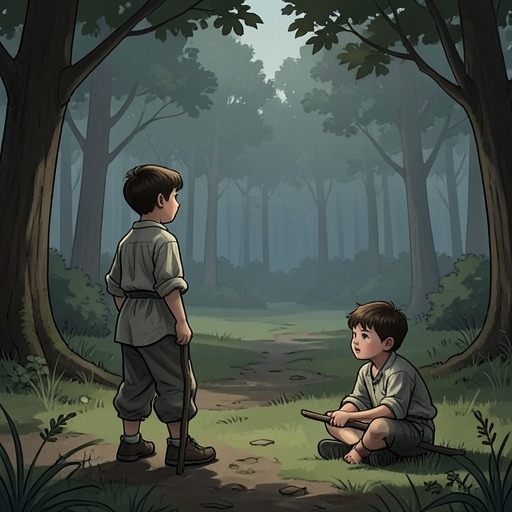
As [Ronia](entity:character-recall-character-ronia-2583bf9bc80a) peers into [Hell’s Gap](entity:location-recall-location-hell-s-gap-538ad41f41b5), she spots a boy of her own age sitting on the other side. He introduces himself as [Birk Borkason](entity:character-recall-character-birk-borkason-183242f3b0a7) and says that he, [Borka](entity:character-recall-character-borka-81cf6a30f1f1), [Undis](entity:character-recall-character-undis-a39272d329e5), and their robbers have moved into the northern half of the fortress. Ronia is enraged to learn they have renamed it [Borka’s Keep](entity:location-recall-location-borka-s-keep-afbde4636459), while [Birk](entity:character-recall-character-birk-1a9fb5e379e9) insists that each side calls the other’s robbers dirty devils.
Ronia and Birk’s first meeting
The Leaps Across Hell’s Gap
[Birk](entity:character-recall-character-birk-1a9fb5e379e9) leaps across the chasm to taunt [Ronia](entity:character-recall-character-ronia-2583bf9bc80a), and she follows, then jumps back and forth to prove she can match him. During the reckless contest, Birk slips on a loose stone and falls into the depths, landing on a narrow projection in the broken wall. Ronia lowers [Ronia’s leather rope](entity:object-recall-object-1a182ab5b847) and braces herself behind a fallen block until she hauls him to safety.
immediately after Birk’s fall
A Rescue Repudiated
Once safe, [Birk](entity:character-recall-character-birk-1a9fb5e379e9) says that perhaps the rescue has tied them together without a rope, but [Ronia](entity:character-recall-character-ronia-2583bf9bc80a) rejects the idea and punches him on the nose. He thanks her, then leaps back to [Borka’s Keep](entity:location-recall-location-borka-s-keep-afbde4636459) with a promise that they will meet again. Their antagonism is real, but the rescue has already begun to complicate it.
the evening after Ronia meets Birk
Borka’s Occupation Revealed
[Ronia](entity:character-recall-character-ronia-2583bf9bc80a) reports that [Borka’s robbers](entity:character-recall-character-borka-s-robbers-020dac0ad9dd) have taken over the North Fort, but [Matt](entity:character-recall-character-matt-49128ced0765) initially calls her story a lie. Fooloks confirms that [Borka](entity:character-recall-character-borka-81cf6a30f1f1) has a son and that [Undis](entity:character-recall-character-undis-a39272d329e5) gave birth during the storm on the night Ronia was born. Matt’s shock turns to fury as he realizes Borka has occupied the adjoining half of his ancestral fortress.
the same evening
Matt’s Fury and the Guard
[Matt](entity:character-recall-character-matt-49128ced0765) smashes tankards, food, and a soup cauldron in a rage while [Ronia](entity:character-recall-character-ronia-2583bf9bc80a) confirms the invaders’ new name for their stronghold. After [Lovis](entity:character-recall-character-lovis-7310fd72cd02) makes him clean up his own destruction, the robbers consider how [Borka](entity:character-recall-character-borka-81cf6a30f1f1) entered despite their watch at the [Wolf’s Neck](entity:location-recall-location-wolf-s-neck-4b930fe3c076). [Noddle-Pete](entity:character-recall-character-noddle-pete-35e581a97049) suspects the unguarded northern cliff, and Matt posts guards there as well as at the gap.
the morning after the occupation is discovered
The Standoff at Hell’s Gap
[Borka](entity:character-recall-character-borka-81cf6a30f1f1) and [Matt](entity:character-recall-character-matt-49128ced0765) confront each other across [Hell’s Gap](entity:location-recall-location-hell-s-gap-538ad41f41b5), trading insults before discussing Borka’s need to escape the soldiers in [Borka’s Wood](entity:location-recall-location-borka-s-wood-2720eaae2c3c). Borka explains that [Birk](entity:character-recall-character-birk-1a9fb5e379e9) climbed the northern cliff with a rope and found an old pig-feeding door hidden in the rock, allowing the band to enter the North Fort. Neither chief can safely force a fight across the gap, so both leave the confrontation unresolved.
the autumn after Borka’s occupation
The Secret Rope Ladder
[Matt](entity:character-recall-character-matt-49128ced0765)’s attempts to dislodge [Borka](entity:character-recall-character-borka-81cf6a30f1f1) fail, and [Noddle-Pete](entity:character-recall-character-noddle-pete-35e581a97049) tells him that force will not be enough. While scouting, Matt sees [Borka’s robbers](entity:character-recall-character-borka-s-robbers-020dac0ad9dd) lower their rope ladder and charges up it with his men. Arrows drive them back, and [Little-Snip](entity:character-recall-character-little-snip-a2e0af63130c) is wounded in the thigh; the failed assault confirms how closely guarded Borka’s access route is.
later that autumn
Ronia Saves Birk in the Fog
After arguing with [Birk](entity:character-recall-character-birk-1a9fb5e379e9) about whose woods they are, [Ronia](entity:character-recall-character-ronia-2583bf9bc80a) finds herself and him caught in a dense mist. She gives him a rope to guide him home, though she insists on keeping a rope’s length between them. [The Unearthly Ones](entity:character-recall-character-the-unearthly-ones-624f9c651fd1) sing from the fog, and Ronia is drawn toward their alluring music until Birk yanks her back; when the mist lifts, he has protected her, though she has bitten his cheek.
that evening
The Robber’s Calling
[Ronia](entity:character-recall-character-ronia-2583bf9bc80a) asks [Matt](entity:character-recall-character-matt-49128ced0765) what [Borka](entity:character-recall-character-borka-81cf6a30f1f1) meant by saying he had taken things without asking. Matt admits that a robber steals from others and proudly expects Ronia to inherit his leadership. Ronia refuses, unwilling to cause people grief by taking their belongings, and Matt’s attempt to justify his life by claiming to help the poor is punctured by [Noddle-Pete](entity:character-recall-character-noddle-pete-35e581a97049)’s teasing.
the rest of autumn
A Winter of Rivalry
The rival bands’ conflict stalls their robbing, while [Matt](entity:character-recall-character-matt-49128ced0765) spends his days planning how to drive [Borka](entity:character-recall-character-borka-81cf6a30f1f1) out. The robbers become restless, so [Lovis](entity:character-recall-character-lovis-7310fd72cd02) puts them to work cleaning animal pens, and Matt takes them hunting elk. [Ronia](entity:character-recall-character-ronia-2583bf9bc80a) continues her solitary forest life and longs to catch a wild horse, while the autumn woods grow increasingly quiet.
early winter
Ronia’s Winter Trap
While skiing through fresh snow, [Ronia](entity:character-recall-character-ronia-2583bf9bc80a) loses a ski and plunges her leg through the roof of an underground Rumphob dwelling. The [Rumphobs](entity:creature-recall-creature-ba8c01fef702) misunderstand her predicament and treat her dangling foot as a cradle for their child. Unable to free herself, she begins to fear she will freeze before anyone finds her.
the same winter day
The Harpy’s Threat
A Wild harpy lands beside the trapped [Ronia](entity:character-recall-character-ronia-2583bf9bc80a), claws at her, and threatens to take her to the mountains for forced labor. It leaves to summon its sisters, while snow begins to cover Ronia and she imagines [Matt](entity:character-recall-character-matt-49128ced0765) and [Lovis](entity:character-recall-character-lovis-7310fd72cd02) never finding her. Her fear peaks just as a voice calls her name through the storm.
the same winter day
Birk Frees Ronia
[Birk](entity:character-recall-character-birk-1a9fb5e379e9) arrives on skis after finding [Ronia](entity:character-recall-character-ronia-2583bf9bc80a)’s missing ski and works to free her leg from the Rumphob hole. Ronia clings to him in terror and begs him not to leave; he jokes but stays until she is free. He accompanies her through the snow toward the [Wolf’s Neck](entity:location-recall-location-wolf-s-neck-4b930fe3c076), and she asks him to be her brother; he accepts, calling her his sister.
the winter after Ronia and Birk become siblings
The Storm-Bound Fort
A severe snowstorm buries the [Wolf’s Neck](entity:location-recall-location-wolf-s-neck-4b930fe3c076) and isolates the fortress, ending the robbers’ immediate danger from one another. [Ronia](entity:character-recall-character-ronia-2583bf9bc80a) develops a high fever after her ordeal, frightening [Matt](entity:character-recall-character-matt-49128ced0765), who is convinced she may die. [Lovis](entity:character-recall-character-lovis-7310fd72cd02) treats her with herbs, and she recovers after three days, now determined to find a way to see [Birk](entity:character-recall-character-birk-1a9fb5e379e9) despite the snow.
later in the winter
The Buried Passage
Unable to reach [Birk](entity:character-recall-character-birk-1a9fb5e379e9) through the snowbound forest, [Ronia](entity:character-recall-character-ronia-2583bf9bc80a) revisits the underground passages beneath the fortress. The lightning that opened [Hell’s Gap](entity:location-recall-location-hell-s-gap-538ad41f41b5) also caused a rockfall in the tunnel linking the two halves. She begins hauling away the rubble bucket by bucket, driven by the hope that the passage will bring her to Birk.
near the end of winter
A Secret Meeting Underground
After clearing enough rubble to cross, [Ronia](entity:character-recall-character-ronia-2583bf9bc80a) hears someone whistling on the other side and recognizes [Birk](entity:character-recall-character-birk-1a9fb5e379e9)’s tune. They joyfully confirm that they still want to be brother and sister, but footsteps approach from the cellar entrance. Ronia hides her work from [Noddle-Pete](entity:character-recall-character-noddle-pete-35e581a97049), then quietly arranges to meet Birk the next day.
the following morning and through the remaining winter
Food Across the Rubble
[Ronia](entity:character-recall-character-ronia-2583bf9bc80a) meets [Birk](entity:character-recall-character-birk-1a9fb5e379e9) in the passage and discovers that his family is near starvation. [Borka](entity:character-recall-character-borka-81cf6a30f1f1)’s band has run out of provisions, with no livestock left in the keep and their horses wintered elsewhere. Ronia shares her bread and milk, then secretly carries flour and peas for Birk to pass on to [Undis](entity:character-recall-character-undis-a39272d329e5); she also combs his hair, turning a hidden passage into a lifeline between the divided households.
as winter begins to thaw
The Robbers’ Snow Bath
[Lovis](entity:character-recall-character-lovis-7310fd72cd02) drives [Matt’s robbers](entity:character-recall-character-matt-s-robbers-22aaa6f1e0f2) into the snow to wash away months of grime, while [Noddle-Pete](entity:character-recall-character-noddle-pete-35e581a97049) refuses to bathe and jokes about his approaching death. [Matt](entity:character-recall-character-matt-49128ced0765) lifts him tenderly and insists that he must not die behind his back. The scene briefly restores the fort’s rough cheer as Lovis feeds the clean, awkwardly dressed men chicken soup.
the first spring after the long winter
The Return of Spring
Snowmelt floods the cliffs and the river, and [Matt](entity:character-recall-character-matt-49128ced0765) finally allows [Ronia](entity:character-recall-character-ronia-2583bf9bc80a) to leave the fort. She runs back to the lake and finds [Birk](entity:character-recall-character-birk-1a9fb5e379e9) waiting. They celebrate the season’s return with a spring yell and watch wild horses thunder through the forest, then decide to try catching two so they can ride together.
their first spring in the forest
Villain and Savage
[Ronia](entity:character-recall-character-ronia-2583bf9bc80a) and [Birk](entity:character-recall-character-birk-1a9fb5e379e9) capture two young stallions and name them Villain and Savage, but the horses fight their ropes and refuse to be ridden. After tending and watering them, the children mistake temporary calm for tameness; Ronia mounts Villain and is thrown into the lake as both horses bolt. The failed first ride begins a longer effort to earn their trust and control.
one evening in spring
Bumper’s Wound
[Ronia](entity:character-recall-character-ronia-2583bf9bc80a) returns to the fort to find Bumper wounded and [Lovis](entity:character-recall-character-lovis-7310fd72cd02) tending him. [Noddle-Pete](entity:character-recall-character-noddle-pete-35e581a97049) explains that [Matt](entity:character-recall-character-matt-49128ced0765)’s band had robbed travelers on [Robbers’ Walk](entity:location-recall-location-robbers-walk-9bd34a3d883d), then [Borka](entity:character-recall-character-borka-81cf6a30f1f1)’s men attacked over the booty; Bumper took an arrow in the neck. Matt vows retaliation, and Ronia warns that the feud could destroy both bands.
three days after the children are exchanged
Ronia Leaves Matt’s Fort
[Birk](entity:character-recall-character-birk-1a9fb5e379e9) appears in the forest carrying his belongings and says he can no longer endure [Borka](entity:character-recall-character-borka-81cf6a30f1f1)’s scolding. [Ronia](entity:character-recall-character-ronia-2583bf9bc80a) decides to leave [Matt’s Fort](entity:location-recall-location-matt-s-fort-66031fdeab82) too, choosing a life with him in [Bear’s Cave](entity:location-recall-location-bear-s-cave-034c06b09bd7). She slips out at night after [Lovis](entity:character-recall-character-lovis-7310fd72cd02) falls asleep, says goodbye to the guards, and walks through the moonlit forest toward the fire Birk has made.
the first night in Bear’s Cave
A Home in the Cave
[Ronia](entity:character-recall-character-ronia-2583bf9bc80a) reaches [Bear’s Cave](entity:location-recall-location-bear-s-cave-034c06b09bd7) and joins [Birk](entity:character-recall-character-birk-1a9fb5e379e9) beside a fire, recalling [Matt](entity:character-recall-character-matt-49128ced0765)’s saying that where there is a home there is a fire. She struggles to sing [Lovis’s Wolf Song](entity:expression-recall-expression-lovis-s-wolf-song-cabe8faa06bb) because it brings back the home she has left, but the shared shelter and the river’s familiar sound help her settle. At sunrise the children rejoice in their freedom and claim the wilderness as their kingdom.
the first days at Bear’s Cave
Making a Wilderness Home
[Ronia](entity:character-recall-character-ronia-2583bf9bc80a) and [Birk](entity:character-recall-character-birk-1a9fb5e379e9) gather practical supplies, including buckets, Birk’s hidden tools, and a crossbow, while Ronia cuts a bow from juniper wood. [Gray dwarfs](entity:character-recall-character-gray-dwarfs-1efd486edec3) invade the cave and steal a loaf, but the children drive them out and arrange their supplies, fishing net, and hearth. Their household takes shape through work, mutual reliance, and a refusal to live in fear of dangers that have not yet arrived.
a few days after settling in Bear’s Cave
The Lost Knife
After a difficult attempt to carve wooden bowls, [Ronia](entity:character-recall-character-ronia-2583bf9bc80a) and [Birk](entity:character-recall-character-birk-1a9fb5e379e9) quarrel over the missing knife and blame one another. Birk finds it beneath the moss Ronia had gathered for wounds, but anger keeps him from telling her. As evening falls and she does not return, he recognizes that the loneliness of the cave matters more to him than the tool and goes searching for her.
the evening of the knife quarrel
The Wounded Mare
[Birk](entity:character-recall-character-birk-1a9fb5e379e9) hears a frightened horse and finds a mare bleeding from a bear’s attack; [Ronia](entity:character-recall-character-ronia-2583bf9bc80a) arrives, crying that the bear killed the foal. She asks Birk to fetch moss while she comforts the mare, and together they bind the wound. The shadow folk’s presence confirms that the bear has fled, and they lead the injured animal to a spring, name her Lia, and milk her to ease her swollen udder.
the morning after the mare is saved
The Knife Returned
[Ronia](entity:character-recall-character-ronia-2583bf9bc80a) and [Birk](entity:character-recall-character-birk-1a9fb5e379e9) return to the cave with Lia and share the mare’s milk. Birk gives Ronia the knife he found under the moss, and both recognize how easily their unnecessary quarrel had threatened their bond. Their apology turns a practical mistake into a promise to guard their relationship as carefully as their scarce tools.
spring and early summer
Taming the Stallions
As Lia heals and rejoins the wild herd, [Ronia](entity:character-recall-character-ronia-2583bf9bc80a) and [Birk](entity:character-recall-character-birk-1a9fb5e379e9) continue approaching Villain and Savage. Ronia is repeatedly thrown, while Birk eventually stays on Savage’s back long enough to make him stand still. Ronia persists until Villain finally runs himself out and she remains mounted; the two children begin riding together through the forest.
early summer
The Harpy Pursuit
A Wild harpy attacks [Ronia](entity:character-recall-character-ronia-2583bf9bc80a) and [Birk](entity:character-recall-character-birk-1a9fb5e379e9) while they ride, sending Villain and Savage fleeing. The children scatter in opposite directions and hide among trees and boulders as the harpy searches. Once it gives up and returns to the mountains, they find each other unharmed and walk home together, holding hands and cherishing the freedom of their summer.
later in the summer
Lovis Brings Bread
[Little-Snip](entity:character-recall-character-little-snip-a2e0af63130c) finds [Ronia](entity:character-recall-character-ronia-2583bf9bc80a) and [Birk](entity:character-recall-character-birk-1a9fb5e379e9) at [Bear’s Cave](entity:location-recall-location-bear-s-cave-034c06b09bd7) with bread and salt from [Lovis](entity:character-recall-character-lovis-7310fd72cd02), who has correctly guessed where her daughter is living and what the children need. Ronia asks how [Matt](entity:character-recall-character-matt-49128ced0765) is faring and learns that he has not laughed since she left, though he still refuses to say her name. She remains unwilling to return unless Matt himself asks her, while Birk reacts bitterly to the reminder of her family.
the height of summer
The Summer Store
[Ronia](entity:character-recall-character-ronia-2583bf9bc80a) and [Birk](entity:character-recall-character-birk-1a9fb5e379e9) make the most of the warm season, fishing, riding, swimming, and watching the forest’s animals. Ronia describes gathering the season’s sensations into a store of summer to sustain her when winter comes. As the light nights fade and the first autumn colors appear, they avoid speaking about the change they both can see.
late summer
The River Harpy Attack
A flock of [Wild harpies](entity:character-recall-character-wild-harpies-ec242bdb0134) descends while [Ronia](entity:character-recall-character-ronia-2583bf9bc80a) and [Birk](entity:character-recall-character-birk-1a9fb5e379e9) bathe in the river, trapping them in the current and circling above them. Birk clings to a fallen birch and calls Ronia to join him; they hide beneath its leafy branches as the harpies search overhead. Carried toward [Greedy Falls](entity:location-recall-location-greedy-falls-f5df2464ddcf), they cling to each other, preferring the river’s danger to the harpies’ claws.
moments after the harpies lose sight of them
The Escape from Greedy Falls
The birch strikes [Greedy Hump](entity:location-recall-location-greedy-hump-7d754d266580) and swings toward the bank, giving [Ronia](entity:character-recall-character-ronia-2583bf9bc80a) and [Birk](entity:character-recall-character-birk-1a9fb5e379e9) a chance to leave the branch and fight the current. They struggle through the eddies until Birk pulls Ronia into smoother water, and together they haul themselves onto shore. They sleep in the sun, only realizing later that they have survived, then return to [Bear’s Cave](entity:location-recall-location-bear-s-cave-034c06b09bd7).
the evening after the river escape
Lovis at Bear’s Cave
[Lovis](entity:character-recall-character-lovis-7310fd72cd02) waits at [Bear’s Cave](entity:location-recall-location-bear-s-cave-034c06b09bd7) and greets [Ronia](entity:character-recall-character-ronia-2583bf9bc80a), but [Birk](entity:character-recall-character-birk-1a9fb5e379e9) refuses to welcome an uninvited guest, repeating a lesson from [Undis](entity:character-recall-character-undis-a39272d329e5). Ronia is furious at his coldness and ashamed of the conflict pulling her between home and her chosen brother. She cries beside Lovis, who tells her that [Matt](entity:character-recall-character-matt-49128ced0765) calls for her in his sleep and weeps nightly, though he will not ask her to return while awake.
the morning after Lovis visits
Birk’s Winter Fear
[Birk](entity:character-recall-character-birk-1a9fb5e379e9) admits that he fears losing [Ronia](entity:character-recall-character-ronia-2583bf9bc80a) when winter forces her back to [Matt’s Fort](entity:location-recall-location-matt-s-fort-66031fdeab82), leaving him alone in the cave. He expects to remain in [Bear’s Cave](entity:location-recall-location-bear-s-cave-034c06b09bd7) even if the cold kills him, because returning to [Borka](entity:character-recall-character-borka-81cf6a30f1f1) would not let him see her. Ronia refuses to accept this future and insists that she will not abandon him, though neither knows yet how they can survive the winter together.
the late summer turning into autumn
Autumn Closes In
Rain confines the children to the cave, then storms strip the trees and frost whitens the opposite bank. [Birk](entity:character-recall-character-birk-1a9fb5e379e9) keeps calling the weather a bad summer, but [Ronia](entity:character-recall-character-ronia-2583bf9bc80a) begins to fear the coming cold and the prospect of having no warm home. When she goes to fetch water, she sees [Matt](entity:character-recall-character-matt-49128ced0765) sitting alone at the spring, crying.
the first frosty days of autumn
Matt Asks Her Home
[Ronia](entity:character-recall-character-ronia-2583bf9bc80a) runs to [Matt](entity:character-recall-character-matt-49128ced0765), who embraces her and calls her his child, admitting how much he has suffered. When he asks her to come home, she hesitates and looks toward [Birk](entity:character-recall-character-birk-1a9fb5e379e9), unwilling to leave him to freeze. Matt notices Birk and, instead of demanding that Ronia choose, invites Birk to return with them too, acknowledging that he may learn to tolerate him.
immediately after Matt’s invitation
Birk Accepts Matt’s Invitation
[Birk](entity:character-recall-character-birk-1a9fb5e379e9) resists the idea of living among [Matt’s robbers](entity:character-recall-character-matt-s-robbers-22aaa6f1e0f2), fearing that he would become their whipping boy. [Ronia](entity:character-recall-character-ronia-2583bf9bc80a) tells him she would stay with him if he refused, and that her life would be lost along with his if he froze alone. Birk finally agrees to go, understanding that their bond requires him to protect her life as well as his own.
the same autumn day
A Shared Homecoming
[Matt](entity:character-recall-character-matt-49128ced0765) leads the children back through the forest, singing loudly enough to scatter the wild horses. At the [Wolf’s Neck](entity:location-recall-location-wolf-s-neck-4b930fe3c076), [Birk](entity:character-recall-character-birk-1a9fb5e379e9) pauses to visit [Borka](entity:character-recall-character-borka-81cf6a30f1f1) and [Undis](entity:character-recall-character-undis-a39272d329e5) before joining [Ronia](entity:character-recall-character-ronia-2583bf9bc80a) at [Matt’s Fort](entity:location-recall-location-matt-s-fort-66031fdeab82); Matt welcomes him despite their mutual insults. Ronia returns to [Lovis](entity:character-recall-character-lovis-7310fd72cd02), is bathed and fed, and lies in her old bed, while Matt calls her name simply to make sure she is truly home.
the winter after Ronia returns
A War Against the Sheriff
[Ronia](entity:character-recall-character-ronia-2583bf9bc80a) and [Birk](entity:character-recall-character-birk-1a9fb5e379e9) resume their friendship and spend time in the frosty forest, while Birk lives with his own parents in [Borka’s Keep](entity:location-recall-location-borka-s-keep-afbde4636459). [Matt](entity:character-recall-character-matt-49128ced0765) explains that the [Sheriff’s men](entity:character-recall-character-sheriff-s-men-3367c42a892c) have intensified their pursuit after he freed Pelle and two of [Borka’s robbers](entity:character-recall-character-borka-s-robbers-020dac0ad9dd) from a dungeon. [Noddle-Pete](entity:character-recall-character-noddle-pete-35e581a97049) warns that the separate bands will lose unless Matt and [Borka](entity:character-recall-character-borka-81cf6a30f1f1) unite, but Matt resists the idea of sharing leadership.
early the following spring
Borka Warns Matt
[Borka](entity:character-recall-character-borka-81cf6a30f1f1) arrives at the [Wolf’s Neck](entity:location-recall-location-wolf-s-neck-4b930fe3c076) with news that the [Sheriff’s men](entity:character-recall-character-sheriff-s-men-3367c42a892c) are ambushing robbers and have captured two of his men. [Matt](entity:character-recall-character-matt-49128ced0765) instinctively says that they must teach the soldiers a lesson, then realizes he has spoken of the two bands as one. He proposes joining forces, and Borka agrees, but each assumes that he should command the united group.
the morning after the alliance proposal
The Beast Fight
[Matt](entity:character-recall-character-matt-49128ced0765) and [Borka](entity:character-recall-character-borka-81cf6a30f1f1) settle their leadership dispute through a [Wild Beasts’ Match](entity:concept-recall-concept-wild-beasts-match-8d166155bbe7), fighting barefoot while their men form a ring. The contest permits brutal holds, biting, scratching, and tearing, and both men are bloodied before Matt finally wins. He makes Borka a fellow chieftain but establishes that his own word will carry greater authority.
the feast after the beast fight
The Children Reject Robbery
[Matt](entity:character-recall-character-matt-49128ced0765) and [Borka](entity:character-recall-character-borka-81cf6a30f1f1) celebrate the reunited bands and recall their childhood together, while [Ronia](entity:character-recall-character-ronia-2583bf9bc80a) and [Birk](entity:character-recall-character-birk-1a9fb5e379e9) laugh with them. Matt suggests that Birk will inherit leadership because Ronia refuses it, but Birk publicly swears never to become a robber. The chiefs are dismayed, yet the children’s decision marks a break from the family tradition that has sustained their feud.
later that night
Noddle-Pete’s Silver Secret
[Noddle-Pete](entity:character-recall-character-noddle-pete-35e581a97049) tells [Ronia](entity:character-recall-character-ronia-2583bf9bc80a) that he once saved a Gray dwarf from [Wild harpies](entity:character-recall-character-wild-harpies-ec242bdb0134), and the grateful creature revealed a hidden silver mine. He makes Ronia promise to tell only one living person, then whispers the rest before [Matt](entity:character-recall-character-matt-49128ced0765) interrupts. The secret gives Ronia a possible livelihood beyond robbery and becomes a future plan she shares with [Birk](entity:character-recall-character-birk-1a9fb5e379e9).
the winter after the bands unite
Noddle-Pete’s Last Winter
[Noddle-Pete](entity:character-recall-character-noddle-pete-35e581a97049) grows frail after the beast fight and remains in bed, warmed by [Matt](entity:character-recall-character-matt-49128ced0765) and cared for by [Lovis](entity:character-recall-character-lovis-7310fd72cd02). Matt reports the new band’s successes against the [Sheriff’s men](entity:character-recall-character-sheriff-s-men-3367c42a892c), but Noddle-Pete’s attention turns toward his approaching death. He asks [Ronia](entity:character-recall-character-ronia-2583bf9bc80a) to remember the secret he has entrusted to her, and she promises that she will find the right place when the time comes.
a winter night
The Death of Noddle-Pete
With [Matt](entity:character-recall-character-matt-49128ced0765), [Lovis](entity:character-recall-character-lovis-7310fd72cd02), [Ronia](entity:character-recall-character-ronia-2583bf9bc80a), and the robbers keeping watch, [Noddle-Pete](entity:character-recall-character-noddle-pete-35e581a97049) wakes from his stillness to announce that he is ready to die. He then dies, leaving Matt inconsolable because the old companion has been present throughout his life. The robbers bury him beside the river beneath the first snow, and his absence darkens the fort through the winter.
the spring after Noddle-Pete’s death
A Return to Bear’s Cave
As the snow disappears, [Ronia](entity:character-recall-character-ronia-2583bf9bc80a) and [Birk](entity:character-recall-character-birk-1a9fb5e379e9) look forward to returning to [Bear’s Cave](entity:location-recall-location-bear-s-cave-034c06b09bd7) and consider using [Noddle-Pete](entity:character-recall-character-noddle-pete-35e581a97049)’s secret silver mine to support themselves. Ronia expects resistance, but [Matt](entity:character-recall-character-matt-49128ced0765) unexpectedly says she may go and assures her that the cave remains his old home. [Lovis](entity:character-recall-character-lovis-7310fd72cd02) gives her blessing, and Matt accepts that she will return to the fort in autumn.
the final morning
The Spring Yell
[Ronia](entity:character-recall-character-ronia-2583bf9bc80a) and [Birk](entity:character-recall-character-birk-1a9fb5e379e9) walk through the newly awakened forest to their cave, finding the river, trees, and green thickets as familiar as ever. The wilderness is again their home, and the book closes with Ronia warning Birk that her spring yell is coming. Her cry rings through the forest as a joyful affirmation of freedom, kinship, and a life chosen beyond the robber tradition.